For decades, organisations have operated according to a deeply embedded piece of project management doctrine: the time-cost-quality triangle. The idea was intuitive, if you wanted high quality and speed, you had to pay more. If you wanted low cost and high quality, you had to wait longer. Fast and cheap would always compromise quality. You could optimise two, but never three.
That paradigm is now obsolete.
AI has decoupled the traditional constraints of time and cost. What was once a fixed trade-off has collapsed. Work that would previously require weeks of effort, large budgets, and complex resourcing can now be completed in minutes at a fraction of the cost, often with fewer errors and higher consistency.
Fast no longer means expensive. Cheap no longer means low-quality.
AI amplifies cognition and dramatically reduces the marginal cost of producing high-quality work. For the first time, a project can be fast, affordable, and high quality simultaneously. But this does not mean the world is now constraint-free. It simply means the constraint has shifted.
The New Constraint: Human Assurance
While AI can scale output infinitely, human oversight cannot. Every system, whether in engineering, environmental management, regulatory processes, or consultancy work ultimately relies on one critical layer: assurance.
Assurance is the human judgment that reviews, validates, interprets, contextualises, and governs AI-generated work. It ensures outputs are not only technically correct, but ethically sound, defensible, and aligned with both regulatory and organisational expectations.
In other words: AI scales. Human assurance does not.
This tension is now the central challenge for modern organisations.
The New Triangle: Autonomy, Assurance, Throughput
As AI shifts the boundaries of what’s possible, a new trade-off emerges, one that more accurately reflects the operating realities of AI-enabled work.
- Autonomy: How independently the AI system can operate. High autonomy means fewer human touchpoints and faster cycles.
- Assurance: The level of human oversight, validation, and governance required.
- Throughput: The speed and volume of work the organisation wants to generate.
These three variables now form the new triangle of constraints. And just like the old model, you cannot maximise all three simultaneously.
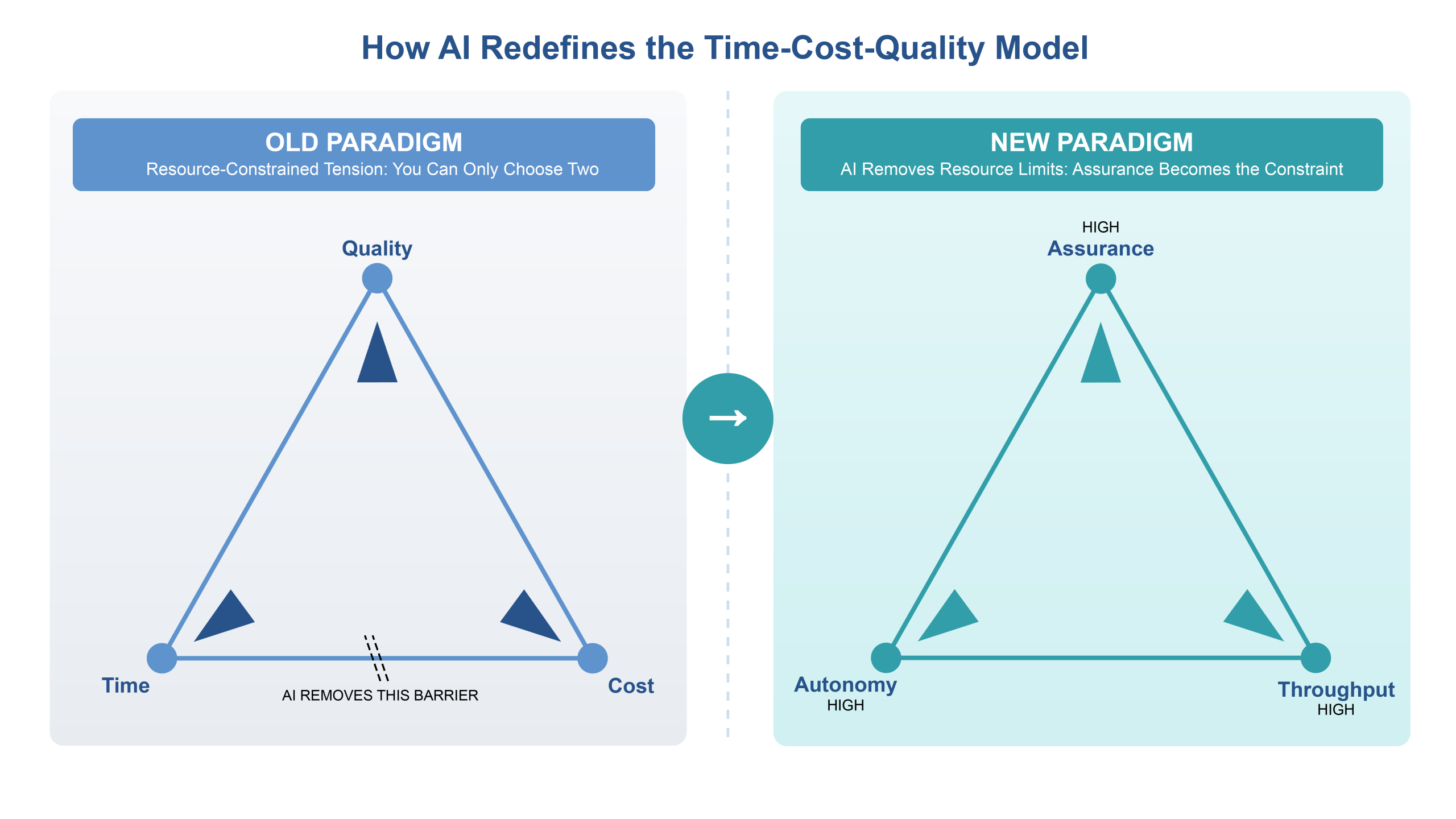
The Trade-Offs (See Diagram Above)
- Autonomy + High Throughput = Lower Assurance AI can move quickly, but the human team cannot review everything.
- Autonomy + High Assurance = Lower Throughput Deep review slows down delivery cycles.
- High Assurance + High Throughput = Lower Autonomy You need more human involvement, reducing the systems independence.
Understanding these trade-offs is the new foundation of strategy.
Why This Matters for Industry
In sectors like offshore energy, where Klarite operates, the implications are profound. These projects intersect with environmental regulation, safety-critical systems, and complex multi-disciplinary processes. The promise of AI is enormous: increased throughput, reduced cost, improved accuracy, and more informed decision-making.
But the risk lies in assuming that speed and scale are inherently valuable. They are not, unless paired with strong assurance frameworks.
AI can accelerate workflows, but without governance it can also accelerate errors. Organisations that thrive will be those that intentionally define:
- Where autonomy is appropriate
- Where assurance must remain high
- Where throughput creates value
- And how to design systems that maintain integrity at scale
This is not a conversation about technology alone; it’s about operating models.
A Strategic Question for Leadership
As AI becomes embedded in every industry, leaders must confront a new question: What do we value most: autonomy, assurance, or throughput?
There is no universal answer. But there must be a deliberate one. Cost and time are no longer the dominant constrains. Assurance is.
Organisations that choose intentionally, and design governance frameworks that support those choices, will shape the next era of industry. At Klarite, our position is clear: Autonomy should scale. But assurance must never degrade.
AI has not simplified the world. It has shifted the complexity. The companies that recognise this, and build systems that balance autonomy, assurance, and throughput will lead with confidence, integrity, and clarity in a rapidly changing world.

Matt Smith, Director
Matt has been Managing Director of Klarite for 8 years and has over 23 years of experience in environmental management. With a background in marine engineering and a Masters of Business Administration from RMIT, Matt founded Klarite in 2017, an environmental services company catering to energy projects in Australia. His expertise spans climate risk management, best practice regulation, environmental policy, and emergency response. Matt has held senior roles in the non-profit, industry, and government sectors.